Custom System · Global

Memecoin utility layer and on-chain arena

Public beta · rektps.com5 localesCommit-reveal fairnessPrivy embedded wallets
Memecoin utility layer and on-chain arena
Snapshot

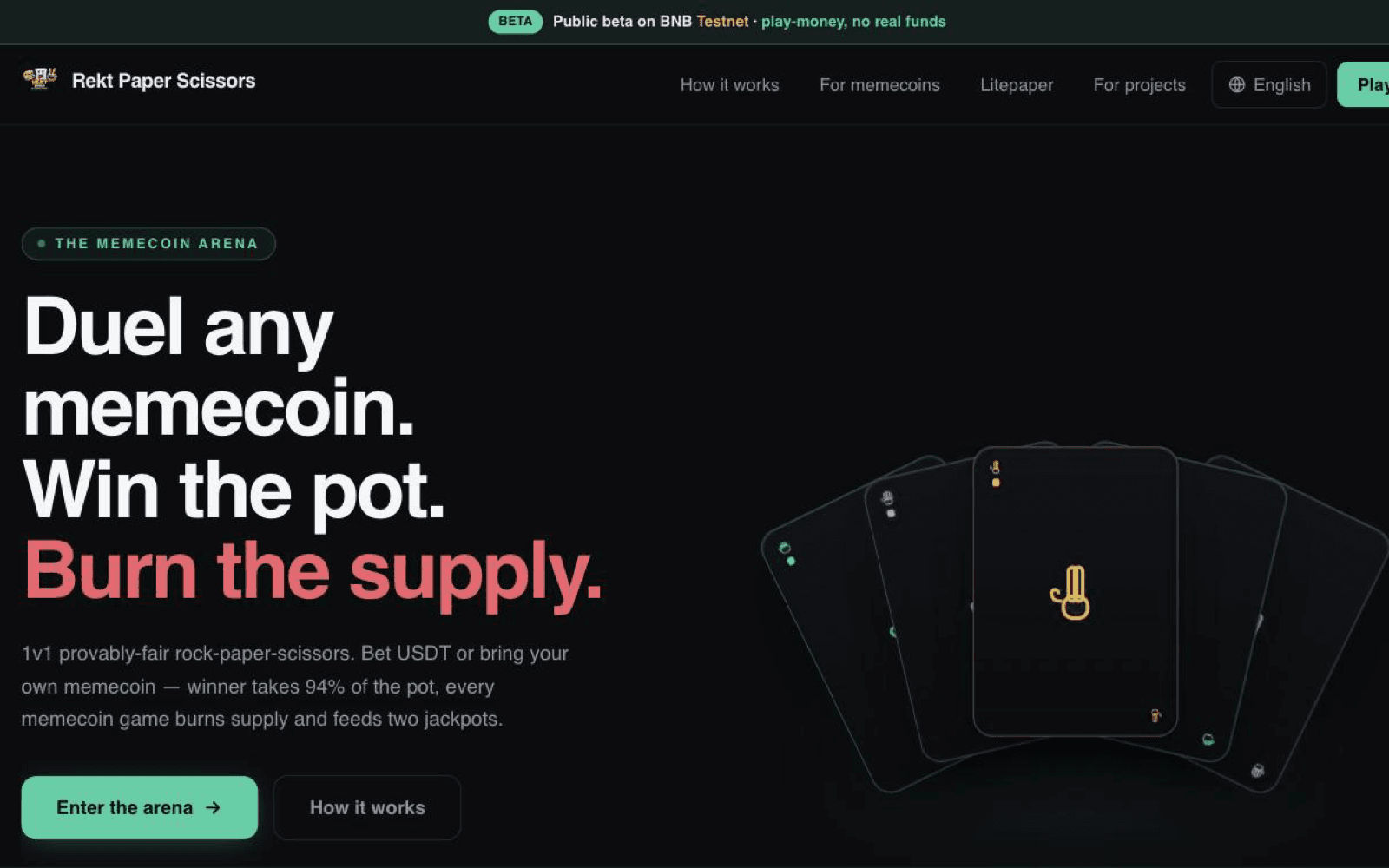
A utility layer for memecoins: any token can be listed as a battle arena where holders duel one-on-one, and every match burns supply and feeds a jackpot denominated in that token. Undertide built the product — marketing site, litepaper, partner funnel, and the game itself: matchmaking, rounds and settlement — with wallet and email onboarding through Privy.

Business
Web3 gaming / token utility
Market
Global
Format
Custom System
Status
Delivered
94%
Of the pot to the winner
0.5%
Of every pot burned
5
Localised front-ends
2 wks
To public beta
How the system runs
List a token
Contract address only
Arena page
Built from DexScreener data
Stake & duel
Best-of-five or one throw
Commit-reveal
Result provable, not asserted
Split
94% winner · jackpots · burn
Business context

The insight the product is built on is stated on its own homepage: most memecoins are just a chart. Thousands of tokens launch with a community, a meme and no mechanism — holders have nothing to do with the token, teams have no deflation story they can point at on-chain, and attention decays. Rekt Paper Scissors treats that as a product gap rather than a marketing one: the paying audience is the token team, and what it buys is a use for its token that requires no contract change and no allocation.

The challenge

The product had to serve two unlike audiences at once. Players want an instant, gas-free match they can trust. Token teams want utility they can adopt without changing a deployed contract or handing over an allocation. And because rounds run off-chain for speed, the fairness of the game had to be demonstrable rather than asserted.

  • Two audiences in one product: players want instant trustable matches, token teams want adoptable utility
  • Off-chain play is required for instant, gas-free rounds — so fairness has to be provable rather than promised
  • Token teams will not modify a deployed contract or hand over an allocation, so listing had to be zero-touch
  • Every listed token needs its own branded arena, its own jackpot and its own burn accounting
  • A staking-and-pot product has to state its economics plainly and in public
How Undertide responded
Decision 01

Commit-reveal under off-chain speed

Matching and rounds run off-chain so a match starts immediately and costs no gas — which moves the trust question to whether a result can be faked. Each move is submitted as a SHA-256 hash of the move plus a secret salt; only once both players have committed does either reveal, and every reveal is checked against its earlier hash. Who wins a round is pure rock-paper-scissors maths on revealed moves, with no server randomness anywhere in the path.
Decision 02

Zero-touch listing

A token team supplies one thing: a contract address. No contract change, no token allocation, no integration work. The arena page then assembles itself — icon, price, liquidity and socials pulled from DexScreener — so a project goes from enquiry to a branded, playable arena without engineering involvement on their side. This is the decision the whole adoption model rests on.

Decision 03

An economy published in full

The winner takes 94% of the pot. The 6% rake is broken out in public — platform, jackpots, player rewards, and a burn on memecoin arenas — rather than described as a fee. Two jackpots per arena, a MEGA and a MINI, accrue from play and are drawn with VRF, and every match earns leaderboard points whether it is won or lost. The litepaper states the effective edge and the risk in the same document.

Decision 04

Email-first onboarding

A wallet requirement is the point where most crypto products lose non-crypto users. Onboarding runs through Privy embedded wallets, so a player can sign in with an email and be in a match without ever installing a wallet — while a crypto-native player connects the wallet they already use. The same account model serves both.

Under the hood

Next.js on Turbopack with five localised routes, an off-chain match engine with commit-reveal verification and logged round history, VRF-drawn jackpots, signed withdrawals, and wallet-or-email onboarding through Privy embedded wallets. Public beta runs on BNB testnet with play-money; mainnet and external audit sit in the client's next phase.

What was delivered
01Marketing site across five localised front-ends
02Litepaper covering the game, the rake split, fairness and roadmap
03Partner funnel for memecoin teams with structured enquiry capture
04Arena: best-of-five card ordering and one-throw modes
05Commit-reveal move submission and server-side verification
06Off-chain matchmaking with skill rating
07Two-jackpot model with VRF draws and ticket accrual
08Published rake split: 94% winner, jackpots, player rewards, burn
09Auto-built branded arena pages from DexScreener data
10Wallet or email onboarding through Privy embedded wallets
What changed
  • Public beta live on BNB testnet two weeks from start, as play-money
  • Full loop running: deposit, blind matching, both game modes, VRF jackpots, signed withdrawals, leaderboard payouts
  • Any token can be listed from a contract address alone, with the arena page auto-built
  • Five localised front-ends serving English, Chinese, Malay, Japanese and Korean
  • Rake split, effective edge and risk disclosure published in the litepaper
  • Token teams enquire through a structured partner funnel rather than DMs

Need a similar result for your business?

If you have a product that has to be fast, verifiable and adoptable without friction, tell us what you're thinking. Undertide will assess fit and recommend the right scope.